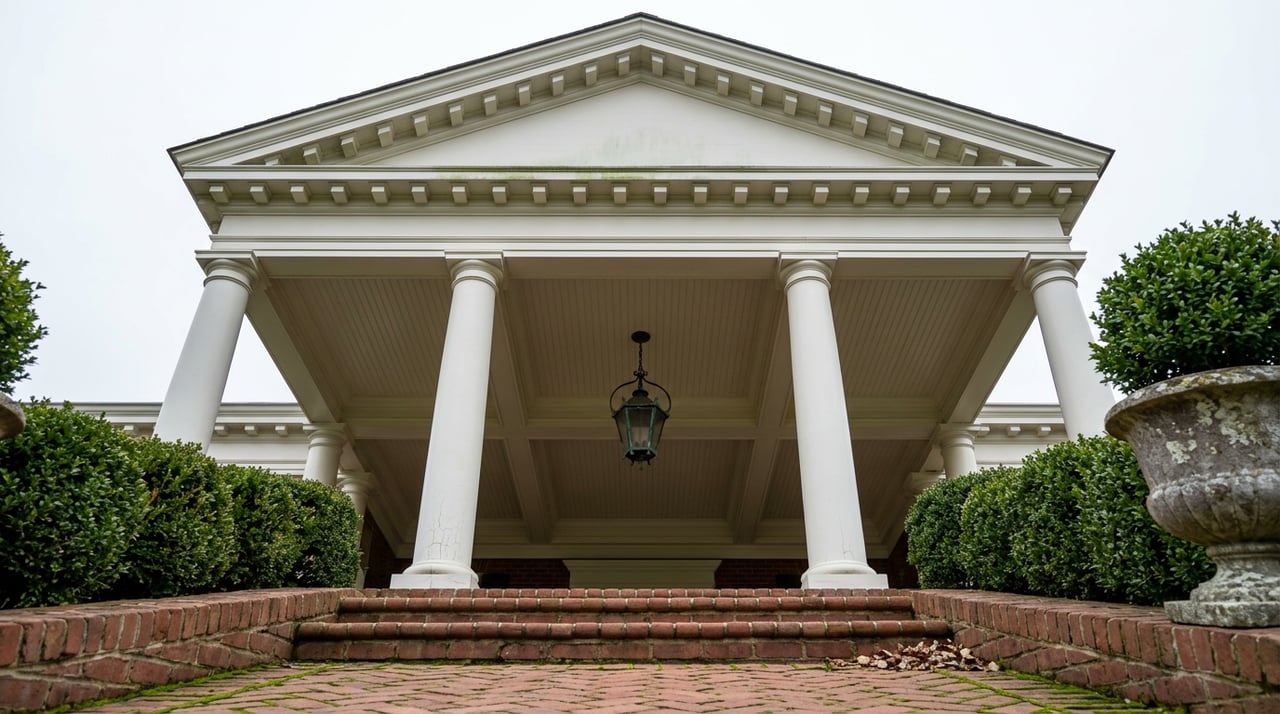
"Completion of the HSM Plan is required before major capital work." Julie Zier of the Friends of the Hermitage said that in January. She was describing the order of work at the Gothic Revival house on North Franklin Turnpike. The roof replacement and the side-porch restoration both have to wait until a full Historic Site Management Plan is written.
The house is still open while that study runs. This month it has a festival, a Halloween dinner and an evening lecture. All three take place at a building that is under formal assessment and that has no published start date for its next round of major repairs.
The October Calendar at 335 N. Franklin Turnpike
| Date | Event | Time | What's listed |
|---|---|---|---|
| Saturday, Oct. 10 | Hermitage Fall Festival | 12:00 p.m. | Food trucks, music, beer garden, petting zoo, pumpkin painting |
| Saturday, Oct. 17 | Murder Mystery Dinner | 6:30 p.m. | Halloween-themed mystery dinner |
| Monday, Oct. 26 | "What's New at the New Jersey State Archives?" | 7:00 to 9:00 p.m. | Free talk in the Hermitage Meeting Room |
The Fall Festival is the biggest public day of the month. It starts at noon on October 10, and the listing promises food trucks, music, a beer garden and a children's program with a petting zoo and pumpkin painting. The listing comes from a community post on Patch and gives no end time or admission price. Check with the museum before you go if either matters to you.
One week later, on October 17 at 6:30 p.m., the house hosts a Halloween-themed Murder Mystery Dinner. That listing also leaves out ticket price and end time, so ask the museum about tickets and reservations.
The talk on October 26 is the quietest of the three, and it's free. "What's New at the New Jersey State Archives?" runs from 7:00 to 9:00 p.m. in the Hermitage Meeting Room. It covers research resources at the State Archives and previews exhibits at the State Archives and the State Museum. It is aimed at anyone who has ever wanted to trace a deed, a family name or a local story back through state records.
What the Study Is Actually Looking At
The planning work behind all of this got its funding in January. The Friends of the Hermitage announced a combined $128,000 in grants from the Bergen County Historical Commission Open Space Trust Fund and the New Jersey Historic Trust to complete a Historic Site Management Plan. ROI-NJ reported the award on January 22, and NorthJersey.com covered it in early February.
The state's share was in the works for months before that. The New Jersey Historic Trust's September 25, 2025 grant notice listed a $75,000 recommended Historic Site Management grant for The Hermitage. The notice also said the money still needed appropriation and the governor's approval before it could be released. By January, the Friends were describing the combined grants as awarded.
The architecture firm Clarke Caton Hintz was chosen to prepare the plan. Its team covers historic-preservation architecture, archaeology, masonry analysis and structural conservation. Work on site began January 15, 2026. The first assessment looks at the building's current condition, its historic fabric and the site's features. The finished plan is meant to serve as a roadmap for long-term preservation, restoration and capital improvements done in phases.
"Completion of the HSM Plan is required before major capital work."
That sentence sets the order of everything that follows. The Friends named roof replacement and side-porch restoration as examples of work that can go ahead once the plan exists. As of this month, no published source gives a completion date for the plan or a construction schedule after it. The roof and porch you see at the Fall Festival are the same ones the consultants have been documenting since winter.
Why a Roof Here Takes a Plan
The paperwork matters because of what the building is. The Hermitage's own architecture page says Elijah Rosencrantz II commissioned the architect William H. Ranlett in 1846. The page calls the house "Gothic Revival, 1846-1847" and dates the new south stone wing to 1847 and 1848. The federal record gives a slightly different date. The National Park Service's National Register nomination says the present house was built or rebuilt for Elijah Rosencrantz Jr. in 1845 from Ranlett's designs. It calls the house an unusually significant early Gothic Revival home by that architect. Both sources put Ranlett's work in the mid-1840s. They differ on the exact year.
Four generations of the Rosencrantz family lived in the house. Mary Elizabeth Rosencrantz was the last. When she died in March 1970, she left the house, five acres and its contents to the State of New Jersey. The house is a National Historic Landmark for its architecture. It was entered in the National Register in 1970 and added to the New Jersey Register a year later.
The Friends of the Hermitage was formed as a nonprofit in 1972 to preserve and restore the site. It runs the house museum under a lease from the state. So the group that schedules October's festival and dinner is also the group managing the planning grant. With that ownership history and those layers of designation, a new roof here becomes a documented preservation project, which explains why masonry and structural conservation specialists are on the planning team.
The Year the Revolutionary Story Came Back Outdoors
The house has an older layer than Ranlett's. The Hermitage's history notes that George Washington and his guards camped near the house from July 11 to 14, 1778, and names Aaron Burr among its wartime visitors. Burr married Theodosia Prevost at The Hermitage on July 2, 1782. It was a double wedding with Theodosia's half-sister.
That history shaped the site's calendar for the nation's 250th anniversary this year. On July 11, 2026, The Revolutionary War at the Hermitage brought militia drills, artisan demonstrations, music by the Enslows and the Tricorne Dancers to the grounds. The date matched the first day of Washington's 1778 encampment. The state Department of Environmental Protection's calendar described the program as a reenactment of that stay, with Outwater's Militia among the participants.
Earlier, on April 26, Glen Rock Women in Community Service held a Traditional High Tea at the house in honor of the 250th anniversary. TAPinto reported 80 attendees. October's lighter mix of a festival, a mystery dinner and an archives talk closes out a year of anniversary programming on this lawn, all of it held while the building itself was being assessed.
Getting the Most Out of a Visit This Month
You can walk the grounds any day. The museum says its 4.9 acres of grounds and gardens are open daily from 9:00 a.m. to 5:00 p.m., and that Bergen County Master Gardeners volunteers maintain the gardens. For a quiet look before or after the October 10 crowd, the grounds hours are the easiest way in.
Going inside means joining a guided tour:
- Tours last about an hour and leave at 1:15, 2:15 and 3:15 p.m.
- Tickets are $10 for adults and $5 for children. Children under five get in free.
- The tours page lists Thursday through Sunday, while the Plan Your Visit page lists Fridays, Saturdays and Sundays. If you're planning on a Thursday, call ahead.
Several of Ho-Ho-Kus's other fall staples have already happened this year. The fifth Ho-Ho-Kus Day filled downtown on September 12 with music, food trucks and a Ducky Derby on Warren Avenue. The Ho-Ho-Kus Inn & Tavern held its Oktoberfest from September 23 to 26. For the rest of October, The Hermitage's three dates make up the main public calendar.
At The Hermitage, the Friends decided to study the building before replacing its roof, and that is a sensible order for any older home. If you own a house of a certain age in Ho-Ho-Kus and want to talk through which projects to put first before a future sale, Daniel Chamoun is glad to help. Schedule a Free Consultation.